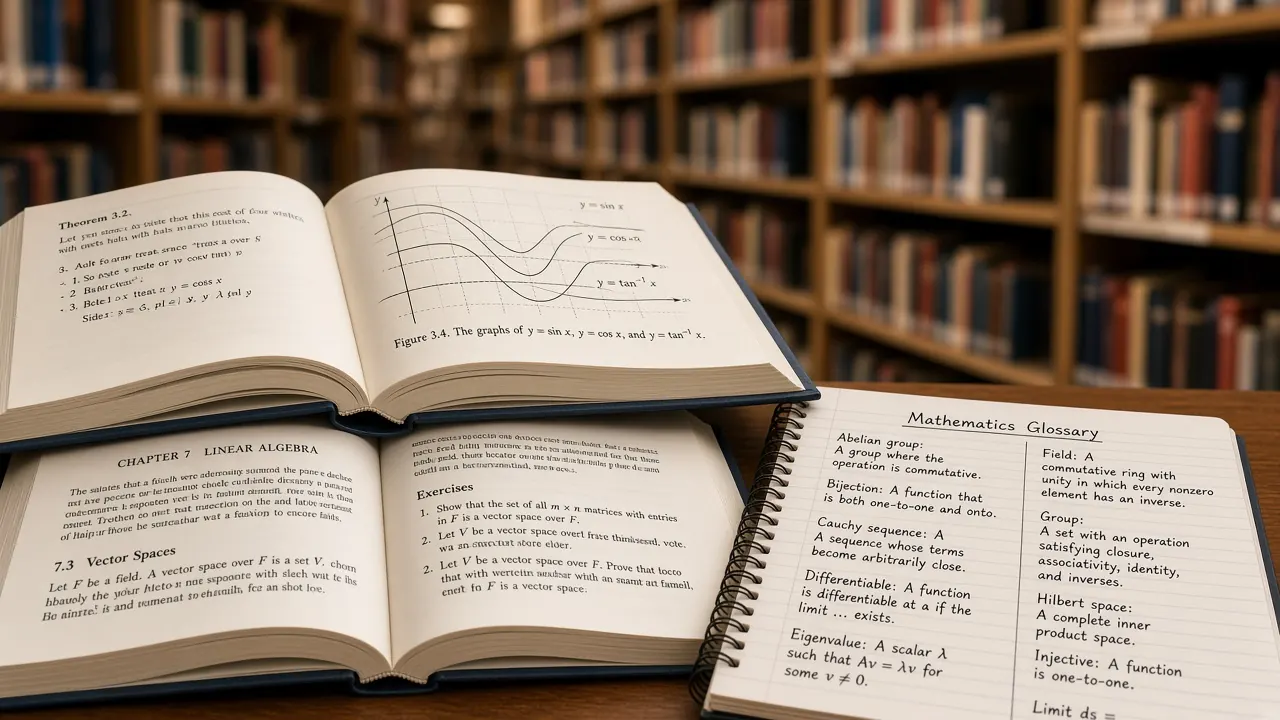
Proofs are explanations that compel agreement from a skeptical but fair reader. This pathway builds that habit inside calculus statements, instead of dumping a symbolic logic course on you at once. It orders the analysis topic, explainers, glossary entries, two calculators used only as pictures, and the sources list.
Who this pathway is for
Start here if a proof course is in front of you, or if your calculus so far was mostly computation. You might compute derivatives easily and freeze when a definition says “for every epsilon there exists a delta.” That freeze is the audience.
Each checkpoint asks you to write and then rewrite. Reading the page is not the step.
Prerequisites
You need algebra, function notation, and the willingness to define a word before you use it. The examples are limits, continuity, and series. If limits are new, read calculus foundations in parallel.
This is not a formal logic course. You will meet “for every” and “there exists” in the order a limit uses them. If derivative language is rusty, repair it with what a derivative actually measures on the AP Calculus AB bridge, then come back.
What you will be able to do
When you finish the checkpoints, you should be able to do the following with a short statement, not with a chapter.
- Unpack a definition into quantifiers before any algebra.
- Write an epsilon delta proof that $\lim_{x\to 2}(4x-1)=7$, in the forward direction.
- Explain why the sum of two functions that are continuous at a point is continuous at that point, using a split of the tolerance.
- State, as an outline, why a bounded monotone sequence of real numbers converges, without inventing a construction of the reals.
- Tell a sequence from a series, and name a convergence test together with the hypothesis it needs.
- Keep one counterexample that kills a false converse, and end a write up by naming what was proved.
Suggested order
Work in this order. Scratch work may run backward from the goal. The write up you keep runs forward.
- Read real analysis and proof habits. Unpack definitions, separate scratch work from the written proof, name quantifiers, and use a counterexample when a universal claim is false.
- Read the short forms: limit, epsilon delta, continuity, sequence, convergence, partial sum, and series. Stay here until you can say which word is a list and which word is a sum of that list.
- Read epsilon delta intuition without terror. Open the numerical limit estimator only as a picture. Its default example is a hole you can fill: samples approach a number while the function may be undefined at the point. That is allowed for a limit. It is not a proof. The FAQ on calculators versus understanding says the same thing.
- Write three proofs of increasing ambition. Details are below. (a) $\lim_{x\to 2}(4x-1)=7$. (b) The sum of two functions continuous at a point is continuous there. (c) A bounded monotone sequence converges. An outline is enough for (c) on the first pass.
- Read sequences, series, and when infinite sums make sense. Partial sums are the meaning of infinite addition. Use the arithmetic and geometric sequence calculator only for a finite sum. A finite total is not a convergence verdict.
- Read convergence tests for series without fog, with the comparison test, the ratio test, and the root test. For each test, write the hypothesis and the case where it stays silent.
- For a full textbook treatment, use the sources page, including MIT OpenCourseWare. This pathway is three checkpoints and a set of habits. It is not that course.
Checkpoints and practice habits
Keep a polished column and a counterexample column. Scratch can be messy. The polished column cannot.
Proof (a). Claim: $\lim_{x\to 2}(4x-1)=7$. Let $\varepsilon>0$. Then $|(4x-1)-7|=4|x-2|$. Choose $\delta=\varepsilon/4$. If $0<|x-2|<\delta$, then $4|x-2|<\varepsilon$. Write it in that order. One window is enough. A smaller positive window also works.
Proof (b). Assume $f$ and $g$ are continuous at $a$, and show $f+g$ is too. You need $|(f+g)(x)-(f+g)(a)|$ small when $x$ is near $a$. The triangle inequality splits that into $|f(x)-f(a)|+|g(x)-g(a)|$. Given $\varepsilon>0$, take a window where $f$ stays within $\varepsilon/2$ and a window where $g$ stays within $\varepsilon/2$. The smaller window makes the sum of those pieces less than $\varepsilon$. End by naming continuity of the sum at $a$.
Proof (c), outline only. A bounded monotone sequence of real numbers converges. For an increasing sequence bounded above, let $L$ be the least upper bound of the set of terms. $L$ is an upper bound, and no smaller number is, so terms must eventually sit close to $L$. Do not invent a construction of the real numbers. An honest outline is enough. The full argument belongs to a book on the sources page.
Counterexample. “If $a_n$ tends to $0$, then the series converges” is false. The terms $1/n$ tend to $0$, and the harmonic series diverges. The other arrow is true: convergence of a series forces the terms to $0$. Sequences, series, and when infinite sums make sense keeps those apart.
Quantifier swap. “For every $\varepsilon>0$ there exists a $\delta>0$” is not “there exists a $\delta$ that works for every $\varepsilon$.” The limit definition lets you choose the window after the tolerance is named.
Common pitfalls for self learners
Scratch may start from the desired inequality. The kept argument starts with “let epsilon be positive.” Proving the converse is a quiet failure, and a silent ratio test (limit of absolute ratios equal to $1$) is not convergence. Convergence tests for series without fog tells you to switch tests. “Clearly” is not a step.
Related reading and the next pathway
If computational calculus still needs repair, use the AP Calculus AB bridge and return when a page asks for epsilon before delta. If the next course is linear algebra with proofs, use the linear algebra first course for pictures, then prove that two vectors are linearly dependent when one is a scalar multiple of the other.
Who each route is for is on the pathways hub. For open notes beyond this site, use sources.
Start with the analysis topic, then write proof (a) before you open a calculator.
Open proof habits