Educational tool; results are estimates for learning, verify with your textbook or instructor.
This tool evaluates a binomial model $X\sim\mathrm{Binomial}(n,p)$. You enter the number of trials $n$, the number of successes $k$, and a success probability $p$. It reports $C(n,k)$ and $P(X=k)=C(n,k)\,p^k(1-p)^{n-k}$.
The number is meaningful when you really have $n$ independent trials, each with the same success probability $p$, and you care about exactly $k$ successes. Coin tosses, yes or no items on a checklist, and other two outcome repeats can fit. Updating a belief after seeing data is a different job: that is Bayes theorem.
This is not a proof of a probability axiom, and it is not a general statistics package. It does not compute a cumulative tail unless you add terms yourself, and it does not fit $p$ from data. It evaluates one point of one model.
How to use the model
Enter integers $n$ and $k$ with $0\le k\le n$, and a $p$ in $[0,1]$. The default $n=10$, $k=3$, $p=0.5$ is ten fair coin tosses and the chance of exactly three heads. Press Compute.
The first piece $C(n,k)$ counts the ways to place $k$ successes among $n$ trials. The second piece is the probability of one specific pattern of $k$ successes and $n-k$ failures, multiplied by that count.
How to read the output
Read $P(X=k)$ as a point mass, not as “at least $k$” and not as “at most $k$”. If a homework prompt asks for a tail, you must sum several $k$ values. This page will not do that sum for you.
Probabilities use log space arithmetic so moderate $n$ does not overflow as often as a naive $n!$ would. You may still see $0$ for a probability that is smaller than a double can hold. That zero means “too small to represent”, not a proof that the event is impossible in the model.
Common pitfalls
Independence and a constant $p$ are assumptions, not decorations. If later trials depend on earlier ones, or if $p$ drifts, the binomial formula is the wrong model even when the arithmetic is perfect.
$n$ is capped at $1000$ on this page. That is plenty for homework and still finite. Do not treat a capped tool as a statement about infinite populations.
$C(n,k)$ can be a huge integer. The printed value is a floating point number, so very large counts may be rounded. The probability next to it is usually the quantity you wanted anyway.
Related reading
The model sits on probability and statistics. For updating a hypothesis after evidence, use the Bayes theorem calculator and read Bayes theorem without the fog and the Bayes theorem, probability, conditional probability, and random variable glossary entries.
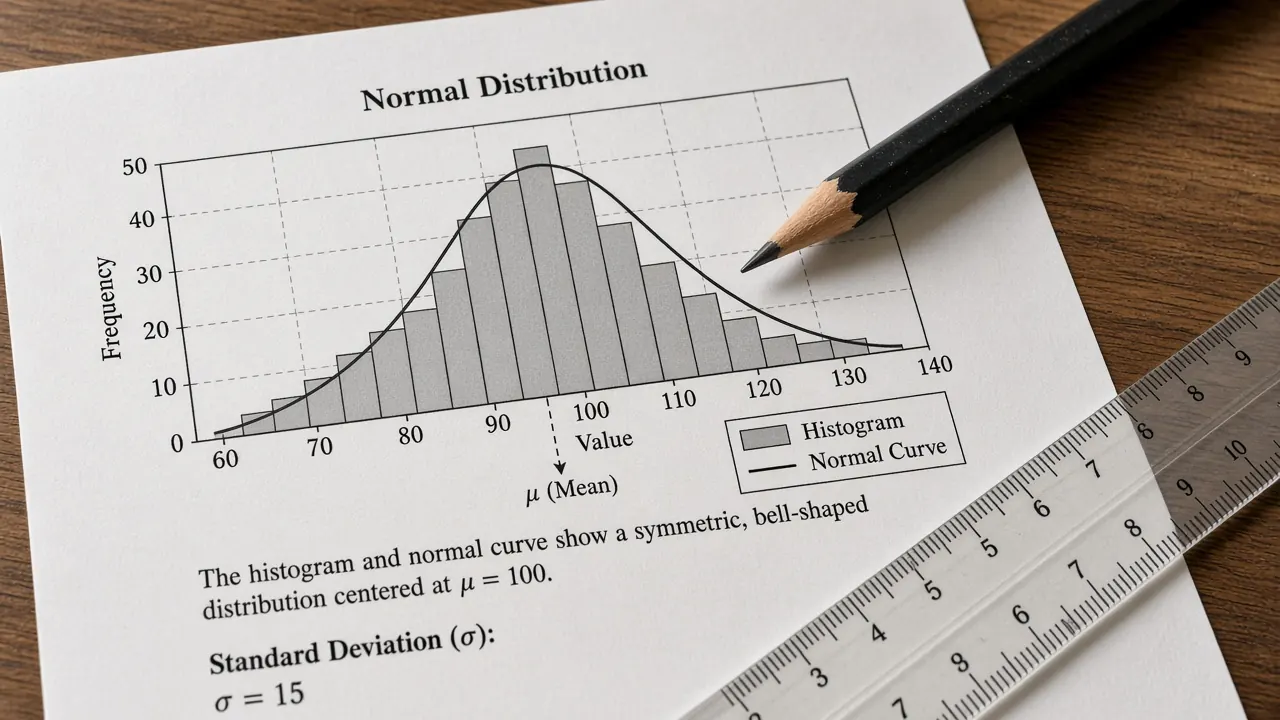
Counting without a probability model is on the combinatorics calculator. A continuous cousin is the normal CDF and z score calculator.